The trip
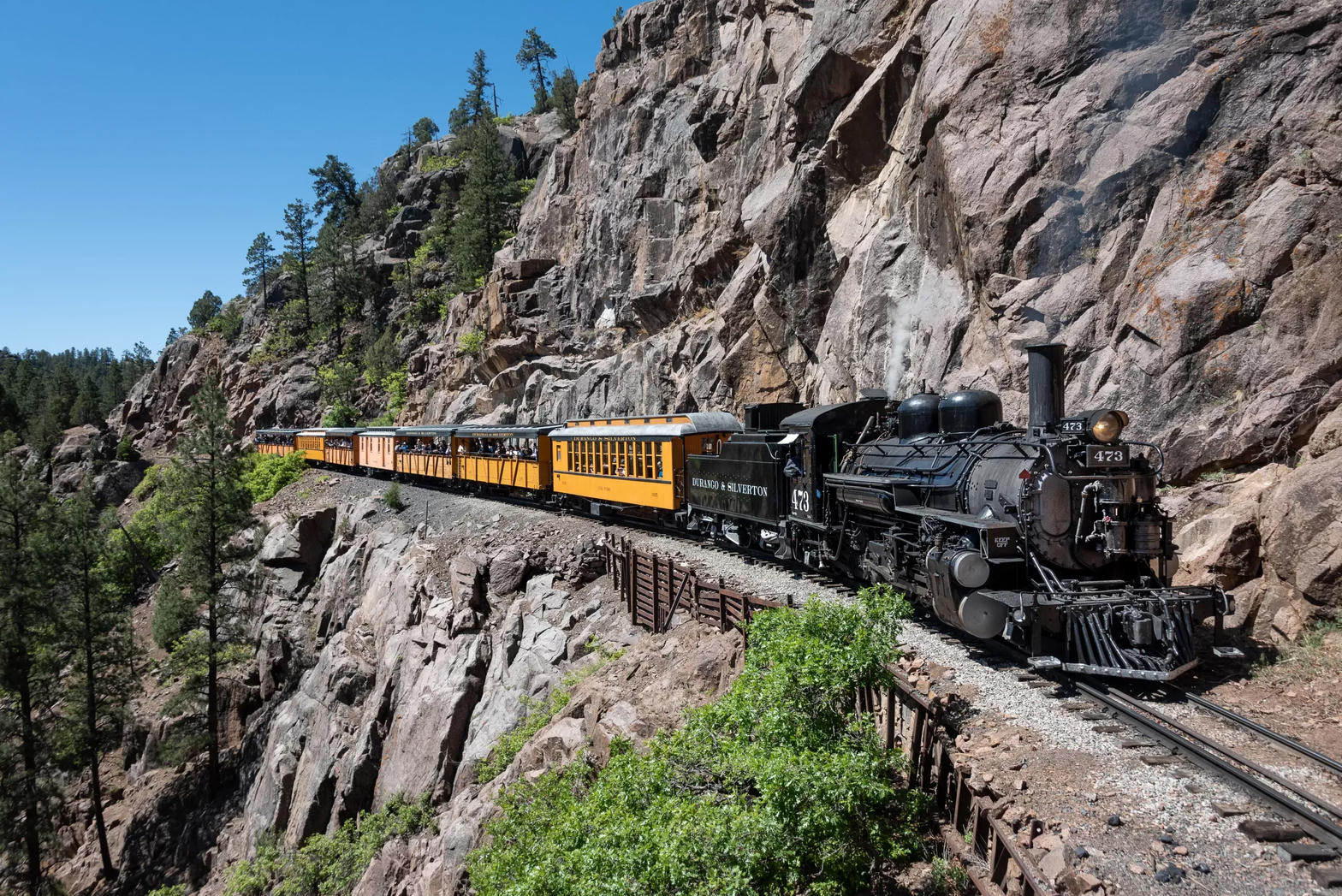
Trains leave downtown Durango and stay with the Animas River into the San Juan National Forest. The rails are three feet apart. The steam engines still working were built between 1923 and 1925. Some of them burn coal, some have been switched to oil, and the railroad runs diesels as well.
Silverton service runs from early May through October, 45.4 miles each way. From late November through early May the turnaround is Cascade Canyon, 26 miles out. A Silverton ticket is a full day. A Cascade ride still leaves the afternoon open. Summer seats go early. Reservations are at (877) 872-4607.
The train crosses the Animas five times. Along the way you pass farmland, the old stage road, the Highline shelf cut into the canyon wall, and the Tacoma power plant. Farther up, some summits clear 14,000 feet and keep snow through the summer. Top speed is 18 miles an hour.
The route and the stops
The brown line is the track, with the Durango depot at the bottom and Silverton at the top. The numbers are the places along it. The sightseeing train does not pause at Cascade, Needleton, or Elk Park for every rider. Cascade is where winter trips end. Needleton and Elk Park are flag stops for hikers going into the Weminuche.
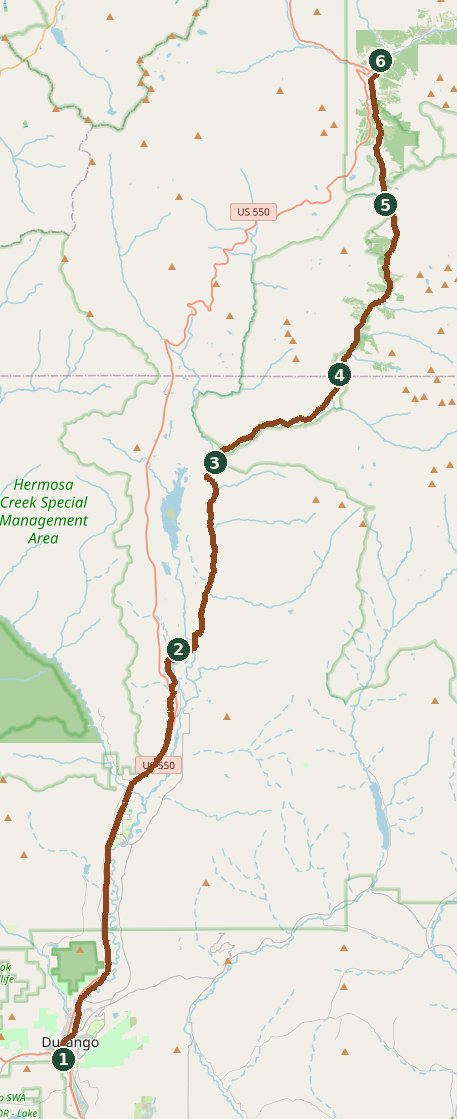
Distances follow the railroad's mileposts, measured along the track. Map data © OpenStreetMap contributors.
- 1
Durango
Start · milepost 451.5
Every train starts at the depot, 479 Main Avenue, at the north end of the historic district. The milepost is still numbered from Denver, not from Durango.
- 2
Rockwood
About 18 miles · last road
About 18 miles out, this is the last place a road can meet the tracks. After Rockwood the canyon is wilderness, and nothing with a motor gets through until Silverton.
- 3
Cascade Canyon
26 miles · winter turnaround
Twenty-six miles from the depot. From late November through early May the train runs out to the wye at Cascade Station and turns around. In summer it continues past here toward Silverton.
- 4
Needleton
Flag stop · Chicago Basin
Not a pause on the regular sightseeing trip. Hikers holding a wilderness ticket get off for Needle Creek and Chicago Basin. There is no southbound pickup here.
- 5
Elk Park
Flag stop · Colorado Trail
The other wilderness flag stop, used for Elk Creek and the Colorado Trail. Hikers coming out catch the southbound train here. You only step off if that stop is on your ticket.
- 6
Silverton
45.4 miles · 9,318 feet
The summer end of the line, early May through October. The ride up is about three and a half hours, then roughly two hours in town before the return. Greene Street and Blair Street are a National Historic District.
History
The Denver & Rio Grande laid this track to haul gold and silver ore out of the San Juans. Tourists were not the point. The railroad reached Durango on August 5, 1881, and started a new town instead of stopping at Animas City, two miles farther up the river. Work on the Silverton branch began that fall. The rails were in by July 1882, a bit under nine months.
Silverton celebrated on July 4, 1882, with the end of track still about two miles short of town. The first work train arrived on July 8. Paying passengers started on July 11, and the first ore left on July 13. Sightseeing trips were already for sale that summer. By the railroad's own account, the branch later moved more than $300 million in precious metal.
Parts of the grade follow the old Animas Canyon toll road. The Highline, the shelf above the river, has been the picture people take of this train since the first years. Mileposts still count from Denver: 451.5 at the Durango depot and 496.9 in Silverton. Around 1970 most of the rest of the line back toward Denver was taken up, and this branch was what remained.
In the late 1960s it was named both a National Historic Landmark and a National Historic Civil Engineering Landmark. Just before the branch turned 100, Charles E. Bradshaw, Jr. bought it from the Denver & Rio Grande Western and put engine 481 back in steam after twenty years sitting idle. The canyon looks much as it did when the ore trains ran.
Worth knowing
- Durango to Silverton is about 2,800 feet of climbing. The Silverton depot sits at 9,318 feet.
- Those 45 miles take about three and a half hours at 18 miles an hour. Time in town is about two hours.
- Engines 480 and 481 are in the restored steam group. Number 497 is the only K-37 on the railroad.
- Movies shot with these trains include Ticket to Tomahawk, Around the World in 80 Days, and Butch Cassidy and the Sundance Kid.
- From Rockwood to Silverton the train is the only ride in. Walking is the other way. The railroad notes that riders sometimes see deer, elk, bighorn sheep, bear, and eagles. Sometimes is the honest word.
- On this stretch the Animas is still a free-flowing river. The train crosses it five times.